
The story behind the castle
One woman's obsession with getting every detail right.
Astolat began as a two-year plan mostly held in one person's head, then took twelve more years, a network of specialist artisans, and a small fortune in gold leaf and stained glass to become the castle it is today.
13 yrs
Design to completion
1996
Acquired by the Freeman family
2015
First public exhibition
30,000
Miniatures in the collection
7
Levels, top to bottom
Meet the maker
Elaine Diehl, a miniaturist based in Colorado, spent two years planning Astolat before construction ever began, holding most of the design in her head rather than on paper. What followed was twelve more years of building, from 1974 to 1987, with goldsmiths, glass blowers, silversmiths, and carpenters brought in from around the world to furnish it to her standard.
Once finished, Astolat went on display in Diehl's own museum shop in Sedona, Arizona, where it became a popular stop for visitors until her retirement in 1996, the same year the castle found its next owners.
Why "Astolat"
The castle takes its name from a tragic figure in Arthurian legend, and the choice was no accident.
Elaine of Astolat is the heroine of Alfred, Lord Tennyson's poem "The Lady of Shalott," a young woman who dies of unrequited love for Sir Lancelot after leaving her tower for one glimpse of him in the outside world. Tennyson's telling turned her into one of the more haunting figures of Victorian poetry: beautiful, isolated, and ultimately undone by her own longing.
It's a fitting namesake for a castle built for no one to live in, a structure made purely to be admired, down to the smallest hinge and windowpane.
“Out flew the web and floated wide; the mirror crack'd from side to side; 'The curse is come upon me,' cried the Lady of Shalott.”
— Alfred, Lord Tennyson, "The Lady of Shalott" (1832)
From workshop to museum
Astolat's story didn't end when construction did; it has changed hands, homes, and audiences in the decades since.
1974
Two years of planning become real
After two years of design work, Elaine Diehl begins construction on Astolat's structural frame.
1987
The castle is completed
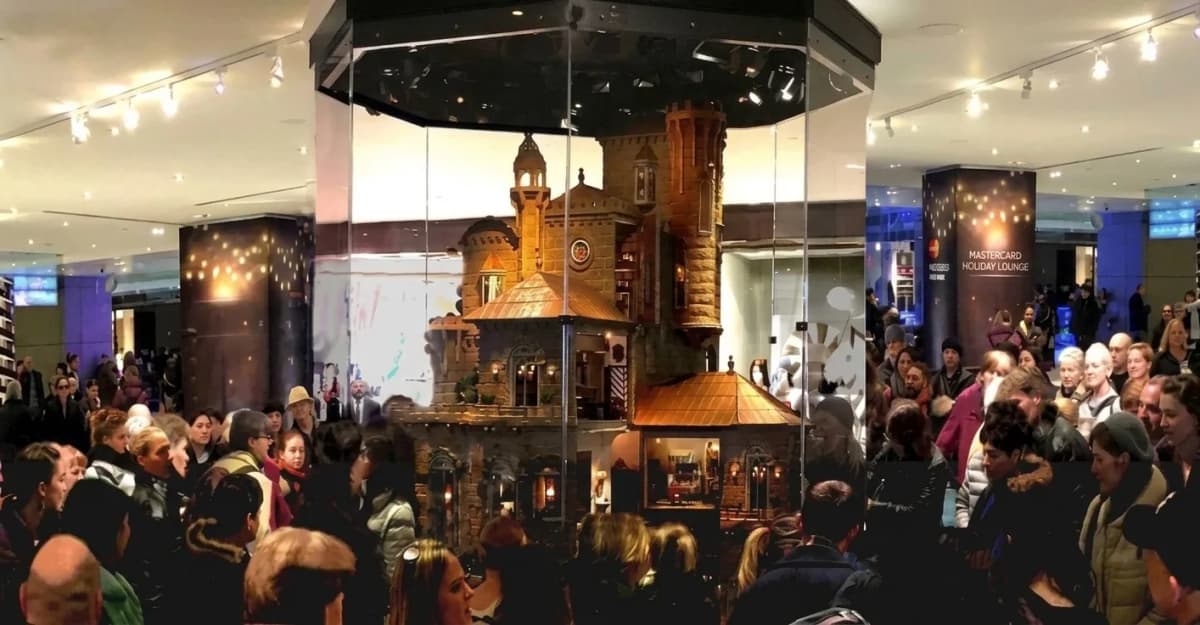
Thirteen years after work began, Astolat is finished: 29 rooms, seven levels, and thousands of hand-crafted miniatures.
1987–96
On display in Sedona
Astolat is exhibited in Diehl's own museum shop in Sedona, Arizona, drawing visitors until her retirement.
1996
A new home, a growing collection
Collectors Michael and Lois Freeman acquire the castle, moving it to the Tee Ridder Miniatures Museum at the Nassau County Museum of Art in Roslyn Harbor, New York. Lois continues adding antique miniatures to the collection in the years that follow.
2015
First public exhibition
Astolat goes on rare public display at The Shops at Columbus Circle, drawing press coverage from Bloomberg, Vanity Fair, and CBS News.
Today
Still growing
Appraised at $8.5 million and recognized as the world's most valuable dollhouse, Astolat continues to be upgraded with new pieces to the highest standard.
As covered by
Bloomberg
Vanity Fair
New York Post
HuffPost
CBS News
How people describe it
“It belongs in the conversation about American miniature art, not as a curiosity but as a serious body of craft.”
— Arts press coverage
“You don't build something like this by accident; every room argues for the next thirteen years of your life.”
— Museum exhibition notes
“A private obsession that somehow became public property, if only for six weeks.”
— Exhibition visitor, Columbus Circle
Come see it for yourself
Astolat travels rarely, but when it does, it's worth the trip. Check in on where it's headed next, or reach out about hosting a future exhibition.